Do Search Engines Still Read Display:none Css
Regardless of how astonishing your theme is, how talented your developers are, or how perfect your website design is, chances are that at some point, you lot're going to desire to change something. Not a lot, just maybe takethis sidebar out, or brand that text box disappear. But on a single page, not everywhere. To practice this, you'll need to understand two specific CSS properties, visibility and display, which can help you lot reach hiding certain elements on item pages by slightly different ways.
Subscribe To Our Youtube Channel
Why Would You lot Want to Hibernate Elements?
I of the more ubiquitous elements that website owners want to hide is the site header. Or perhaps more than specifically, the header nav menu. Maybe a blog post's meta-information or comment department. The question is, why would someone want to do that? Why not remove the data from the site design entirely?
In full general, information technology's because that one, atypical element is in the manner, but its removal isn't worth rewriting the theme or page to cut. Peradventure your About page has a list of blog posts, simply you don't want post meta data there. You lot accept no reason to rewrite a template file for that instance. And so y'all tin remove it by CSS.
Or, every bit another case, you desire to simply nix the comments department on a single post or page without using an editor. CSS will let you either hibernate or remove it entirely without having an impact on any other parts of the site. I popular reason to hide an element with CSS on a specific folio or postal service is to accommodate font or headline size. Where the blog theme and layout still utilize, a seasonal font change for a specific page along with hidden meta-data and sidebar tin be done in a few lines of lawmaking, not a full template adjustment or redesign.
Whatever your reason, though, you have a number of options to hide elements.
How to Find the Element to Hide
If yous know which chemical element you want to hide but not what to call it, you tin ever correct-click on it and selectInspect. This will open theDev Tools pane in your browser, letting you lot find the CSS ID or Class information technology uses.
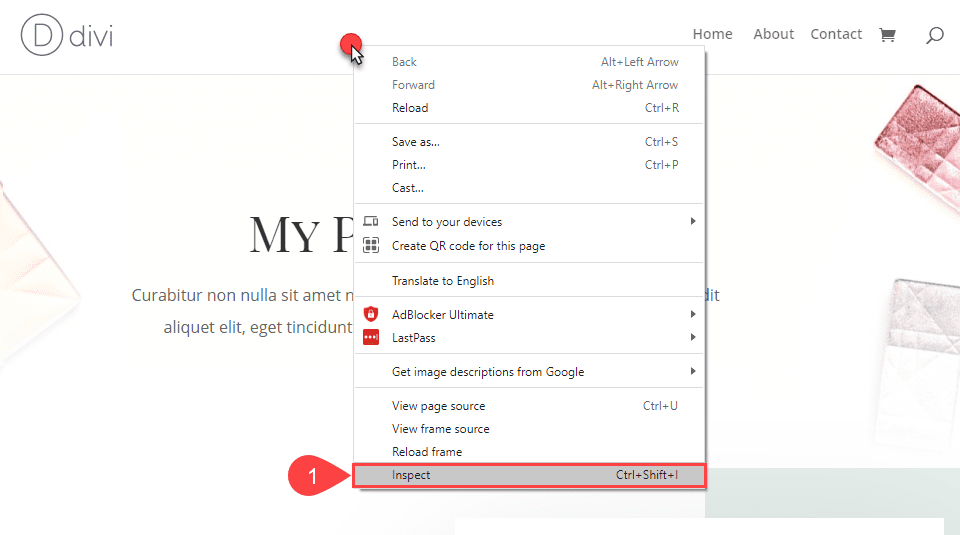
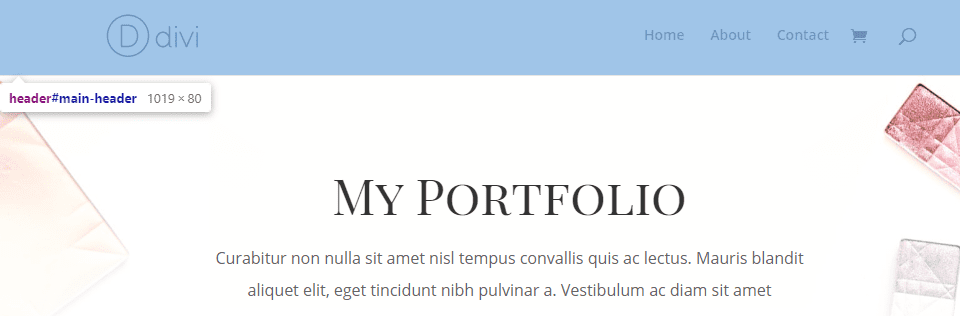
Upon doing and so, the chemical element will be highlighted as y'all hover over and click the correct line(s) in the inspect tool to the right.

After that, it's just using those selectors to adjust with CSS. Note that the selector syntax attached to the chemical element on hover(1) is what volition become in your CSS file/field. The in-line selectors in (2) are what's rendered past the browser.
Using display CSS
The easiest method of hiding an element is to remove it entirely. Thedisplay:none property does simply that. It removes whatever element you attach it to completely. That piece of the page will simply non render anymore, and the space it takes up on the page will be removed and the layout readjusted.
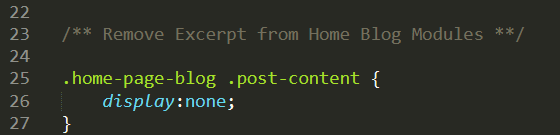
This might be the most mutual style of removing elements on a page. You tin use it as a site-wide removal, or you can target individual pages or post types.
Using visibility CSS
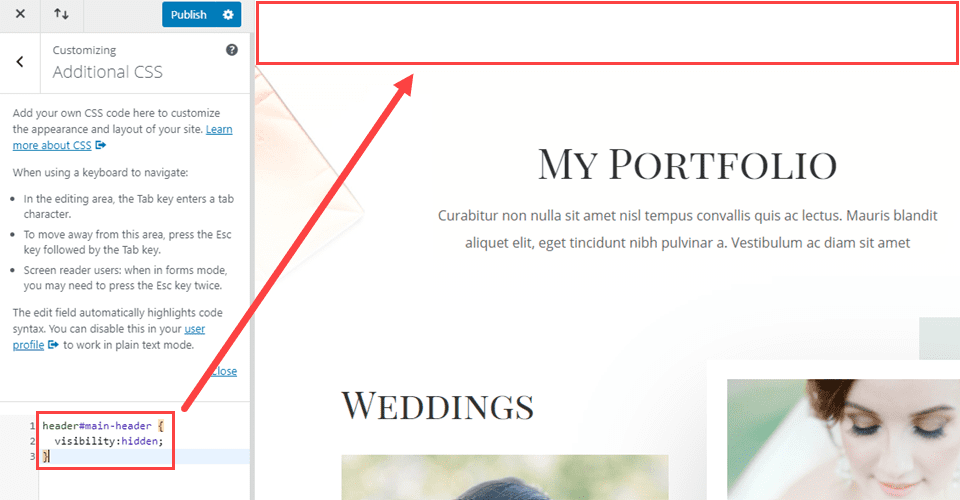
The visibility:hidden CSS is very similar to display:none.In theory, they tin can be used to accomplish the same goal. The big difference, however, is that with this one, yous're not removing the element. Withvisibility, you're but making it invisible. The biggest divergence from a design standpoint is that with visibility, the hidden chemical element itself will however have up space in the pattern.
If yous want to remove the header on a page, but desire to go along the spacing from the top of the DOM, yous volition use this.
When the page renders, the infinite will however be there, simply the element will not.
When to Utilize Visibility and When to use Display
The primary reason to apply one flake if hide chemical element CSS over the other is pretty straightforward. When y'all employ display:none, the entire inheritance of child elements is hidden. Anything that gets its styling or is nested within the element will simply be gone. Withvisibility:hidden, because the space of the element remains, any children of the selected element remain visible.
If, for instance, yous wanted to hide the groundwork of a row and a single column, you would usevisibility:subconscious to maintain formatting and rendering of the other elements, removingonly those you specified. Using brandish:none in this example would remove the entire row or column, reorganizing the folio content.
How to Hide Elements on Specific Pages in WordPress
When information technology comes to hiding elements on specific pages in WordPress with either of these methods, you lot will most likely need to observe thePage ID Class for whichever specific page on which y'all want to hide the chemical element. Continue in mind that it is simple a page ID number not a CSS ID. In fact, it is a CSS class selector:.page-id-1337, for example.
You tin find the page or mail ID in the URL for the edit page. The quickest fashion is to merely hover over the link and come across the preview URL.
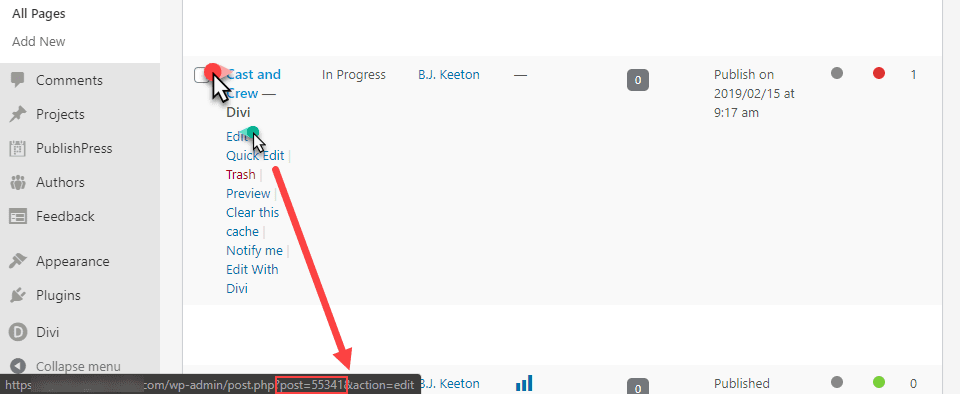
You can also find this ID past looking in the URL bar of anyEdit orPreview page. The number listed in these URLs is the Page ID that you will employ in the CSS selector to target elements on that specific page and nowhere else on the site.
.page-id-55341 header#master-header { brandish:none; } The to a higher place code will remove the header just on the page with that specific ID. Where the following CSS would remove it from every folio and post on the site.
header#principal-header { visibility:hidden; } Wrapping Upward with Hibernate Element CSS
Regardless of your reason, knowing when and the divergence between CSS properties visibility and brandish(and when to use them) tin can assist you customize and highlight different pages on your WordPress sites. Sometimes, you lot might need an prototype to simply not appear on a folio. Or perhaps a blog post doesn't need to accept the meta-data or date showing. Any element you're trying to remove, in that location is some variant of hide element CSS that y'all tin can use to attain your goal.
What reasons have you had to hide elements on specific WordPress pages with CSS?
Article featured prototype past maryliflower / shutterstock.com
Source: https://www.elegantthemes.com/blog/wordpress/hide-element-css
Belum ada Komentar untuk "Do Search Engines Still Read Display:none Css"
Posting Komentar